
Materials, Styles, Printing, Finishes and Design
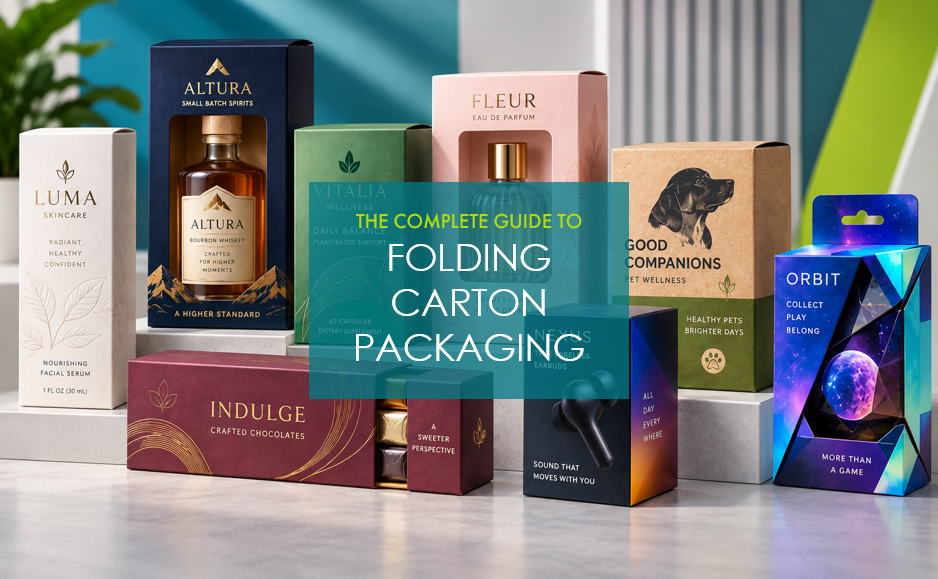
Folding cartons are customizable paperboard packages that are printed, die cut, scored, folded, and glued into shape. Brands use them across beauty, health and wellness, spirits, food and beverage, pet care, electronics, entertainment, and other consumer categories. A well-designed carton protects the product, reinforces brand identity, communicates value, supports efficient packing, and creates a strong first impression.
Industry reference: Paperboard Packaging Council, What Is Paperboard Packaging?
Successful folding carton packaging involves more than placing graphics on paperboard. Structure, materials, printing, finishes, sustainability, filling, and distribution must work together. This guide explains the available options, the production process, and the decisions that help brands develop cartons that perform from the production line to the consumer’s hands.
Folding Carton Packaging Key Takeaways
- Folding cartons are lightweight, customizable packages made from printed paperboard.
- Common styles include straight tuck end, reverse tuck end, auto-bottom, sleeves, windowed cartons, and custom structures.
- Paperboard selection affects print quality, strength, folding performance, sustainability, and perceived value.
- Structural design and prototyping can reveal fit, performance, or production issues before manufacturing.
- An integrated packaging partner can simplify development, improve quality control, and support speed-to-market.
Folding Cartons at a Glance
- Primary material: Coated or uncoated paperboard, including SBS, CRB, CUK, FBB, kraft, recycled-content, and specialty grades
- Common structures: Straight tuck end, reverse tuck end, auto-bottom, sleeves, windows, inserts, and custom structures
- Design options: Inks and coatings, foil, embossing, debossing, tactile and metallic effects, and die cut windows
- Key considerations: Product fit, protection, filling, retail presentation, distribution, sustainability, cost, and consumer experience
- Typical applications: Beauty, health and wellness, spirits, food and beverage, pet care, electronics, entertainment, and other consumer goods
What Is Folding Carton Packaging
A folding carton is made from paperboard that is printed, die cut, scored, folded, and glued into its finished form. Unlike rigid boxes, most folding cartons ship flat and are erected during packing or filling. This format can reduce storage requirements while offering broad flexibility in structure, graphics, and finishing.
Folding cartons range from straightforward product boxes to premium structures with windows, inserts, metallic effects, embossing, specialty coatings, or interactive elements. They can support high-volume product lines, luxury launches, promotional programs, and seasonal packaging.
What Are the Benefits of Folding Cartons
Folding cartons balance brand presentation, product protection, scalability, and material efficiency. Their printable surfaces provide room for visual identity, product information, regulatory language, and storytelling. Dimensions, closures, inserts, and board specifications can be engineered around the product to support protection, packing, retail presentation, distribution, and the opening experience.
What Types of Folding Cartons Are Available
The right carton style depends on the product’s dimensions and weight, the desired presentation, the filling process, and the distribution environment.
Straight and Reverse Tuck End Cartons
A straight tuck end carton has top and bottom closures that tuck from the same direction, leaving the front panel uninterrupted. On a reverse tuck end carton, the closures tuck from opposite directions. Both styles work well for many lightweight products.
Auto Bottom Cartons
An auto-bottom carton has a pre-glued base that locks into place when opened. The structure provides additional strength and can speed assembly during packing.
Sleeves, Windows, Inserts and Custom Structures
Sleeves add branding around a product or tray. Windows reveal the product, while inserts secure and organize components. Custom cartons can incorporate unusual shapes, layered constructions, or interactive openings. Every structure must remain practical to manufacture, fill, ship, display, and use.
Structure should be evaluated as part of the entire packaging system. Product fit, assembly, protection, graphics, filling, distribution, and the consumer experience are easier to address before tooling and manufacturing begin.
Related resource: Folding Carton Packaging Terms Every Brand Should Know
How JohnsByrne Develops Folding Carton Packaging
JohnsByrne brings structural design, prepress, printing, finishing, converting, assembly, and fulfillment together to support packaging from concept through completion.
1 Define the Packaging Requirements
Development begins by understanding the product, brand objectives, timing, quantity, retail environment, filling process, and distribution requirements. These details guide decisions about structure, paperboard, enhancements, testing, and cost.
2 Engineer and Prototype the Structure
A die line is the carton blueprint. It identifies where paperboard will be cut, scored, folded, and glued, and where artwork must be positioned. JohnsByrne’s structural design team can develop concept renderings, paper comps, functional samples, and 3D prototypes. Designs are reviewed with manufacturing, while prototypes help brands evaluate fit, assembly, protection, graphics, and the consumer experience before production.
Learn more: JohnsByrne Structural Design
3 Select the Paperboard
Common materials include SBS, or Solid Bleached Sulfate; CRB, or Coated Recycled Board; CUK, or Coated Unbleached Kraft; FBB, or Folding Box Board; and specialty paperboards. Caliper, coating, recycled content, stiffness, print surface, and grain direction affect performance. The best board is the grade and caliper that meet the package’s requirements without unnecessary material.
4 Prepare Artwork and Manage Color
Prepress connects creative design with manufacturing. Artwork must align with folds, glue areas, windows, foil, embossing, and other production elements. JohnsByrne’s G7-certified processes and in-house ink lab support color accuracy, custom ink development, press approvals, and repeatability across production runs. Aligning prepress, ink development, press standards, and approvals early helps protect color consistency across SKUs.
5 Print and Apply Decorative Effects
During printing, inks and coatings are applied to the selected substrate. JohnsByrne’s uniquely configured 15-unit press that can combine multiple print and coating effects in one press pass. Options include soft-touch, pearl, grit, metallic sheen, strike-through, foil stamping, embossing, debossing, spot varnish, raised tactile effects, and windowing. Digital enhancement can also create raised polymer, flat or raised foil, metallic effects, and variable elements.
Design insight: more embellishment does not necessarily create more impact. Effective finishes establish hierarchy, reinforce the brand, and direct attention to the elements that matter most.
Explore: JohnsByrne Printing and JohnsByrne Finishing
6 Die Cut Fold Glue and Validate
A custom die cuts and scores printed sheets into carton layouts. The cartons are then folded, pre-broken, and glued. Depending on the application, testing such as drop or rub testing may help confirm that the finished package meets functional and distribution requirements.
How Folding Cartons Can Support Sustainability Goals
Sustainable folding carton development requires consideration of the entire package, not a single material claim. JohnsByrne’s Design with Intent approach evaluates structure, material use, recyclability, manufacturing, embellishments, and end-of-use considerations.
Strategies can include right-sizing, lightweighting, increasing recycled or responsibly sourced content, reducing unnecessary components, designing for material separation, and selecting embellishments responsibly. Lifecycle assessment data can help compare materials and structures across carbon footprint, water use, resource consumption, and end-of-life factors. Brands can then balance environmental impact with protection, cost, performance, and brand objectives.
Responsible sourcing reference: Forest Stewardship Council, Paper Print and Packaging
AF&PA reported a 61 – 65% U.S. paper recycling rate for 2025. The recyclability of a specific carton still depends on its components and the collection and processing systems available in the consumer’s community.
Recycling context: AF&PA 2025 U.S. Paper and Cardboard Recycling Rates
Explore: JohnsByrne Sustainable Packaging
What Brands Should Look for in a Folding Carton Manufacturer
A folding carton manufacturer should be evaluated on more than print capability. Look for a partner that can connect structural design, prototyping, prepress, color management, printing, finishing, converting, quality, assembly, and fulfillment across the program.
- Structural design and prototyping that identify risks before production
- Prepress and color-management expertise that supports repeatability
- Printing and finishing capabilities for scalable and premium programs
- Quality systems that support dimensional accuracy and consistency
- Assembly and fulfillment capabilities when programs require downstream execution
- An integrated workflow that reduces handoffs and simplifies communication
JohnsByrne brings these capabilities together as a vertically integrated packaging partner. Its ISO 9001:2015 and G7-certified processes support quality, color consistency, dimensional accuracy, and repeatability across scalable product cartons, decorated premium packaging, and sustainable redesigns.
Related resource: 10 Questions to Ask When Choosing a Packaging Partner
Frequently Asked Questions About Folding Cartons
What are folding cartons made from?
Folding cartons use coated or uncoated paperboard, including SBS, CRB, CUK, FBB, kraft, recycled-content, and specialty grades.
What products use folding cartons?
They package beauty, health and wellness, spirits, food and beverage, pet care, electronics, entertainment, and many other consumer goods.
What is the difference between a folding carton and a rigid box?
A folding carton uses creased paperboard and generally ships flat. A rigid box uses thicker wrapped chipboard and typically arrives preassembled.
What is the difference between a folding carton and a corrugated box?
Folding cartons are generally made from paperboard and suit lightweight consumer products, detailed graphics, and premium finishes. Corrugated boxes use fluted material between linerboards, providing more cushioning and strength for shipping, heavier products, and many retail displays.
Can folding cartons be customized?
Yes. Brands can customize the structure, paperboard, graphics, inks, coatings, foil, embossing, windows, inserts, closures, and opening experience.
Are folding cartons recyclable?
Many paperboard cartons are recyclable, but local systems and components such as laminates, plastic components (if used), coatings, and adhesives can affect recyclability.
Why is prototyping important for folding cartons?
Prototypes help teams evaluate fit, assembly, protection, graphics, and the consumer experience before production. They can also reveal performance or production issues earlier.
How much does folding carton packaging cost?
Cost depends on carton size, paperboard grade, order quantity, print coverage, decorative effects, tooling, assembly, testing, and fulfillment requirements. A packaging partner can prepare a more useful estimate after reviewing the product, structure, specifications, and production volume.
How long does it take to produce folding cartons?
Timing varies with structural development, prototyping, artwork readiness, material availability, tooling, approvals, production complexity, and order quantity. Involving the packaging manufacturer early helps establish a realistic schedule and identify decisions that could affect launch timing.
Bring Your Folding Carton Vision to Life With JohnsByrne
Effective folding carton packaging connects brand presentation with real-world performance. By considering structure, materials, printing, finishing, sustainability, filling, and distribution early, brands can develop packaging that works across manufacturing, retail, and the consumer experience.
JohnsByrne helps brands manage complexity, support speed-to-market, and develop distinctive folding carton packaging at scale. Contact the JohnsByrne team to discuss your next packaging program.
Related Posts
A Guide to Finding the Right Partner for Your Brand Choosing the right packaging partner involves more than finding a manufacturer that can produce a … 10 Questions to Ask When Choosing a Packaging Partner
A practical guide to understanding the language behind custom packaging development Developing folding carton packaging involves far more than selecting graphics and dimensions. Structural design, … Folding Carton Packaging Terms Every Brand Should Know
The pet care industry is evolving rapidly and so are consumer expectations. Today’s pet owners are more discerning than ever, seeking products that reflect the … Elevating Pet Brands Through Premium Packaging & Retail Displays